Introducing Hyperkai – A Hyperbolic Puzzle Game
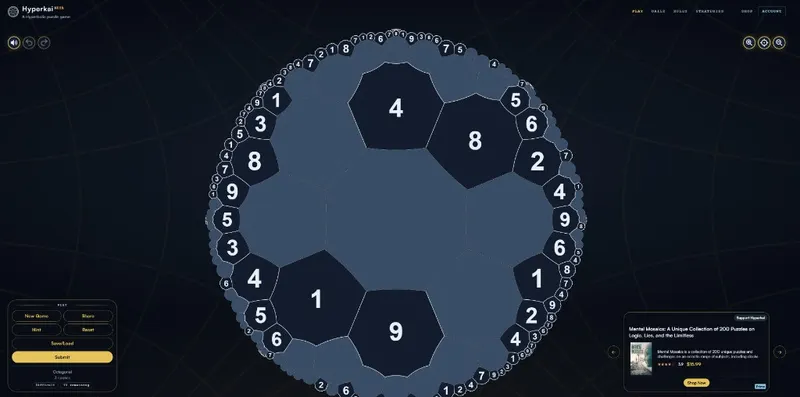
Hyperkai (opens in a new tab) is an original game concept: a single-player game played on a two-dimensional board in hyperbolic space. A Hyperkai board is a cluster of regular tiles built outward from a single center tile. Each puzzle starts with some tiles already filled and the rest empty.
The game is currently available as a beta preview on hyperkai.io (opens in a new tab). I will be spending the next several weeks working on the game before releasing it for Android and iOS.
Rules of the Game
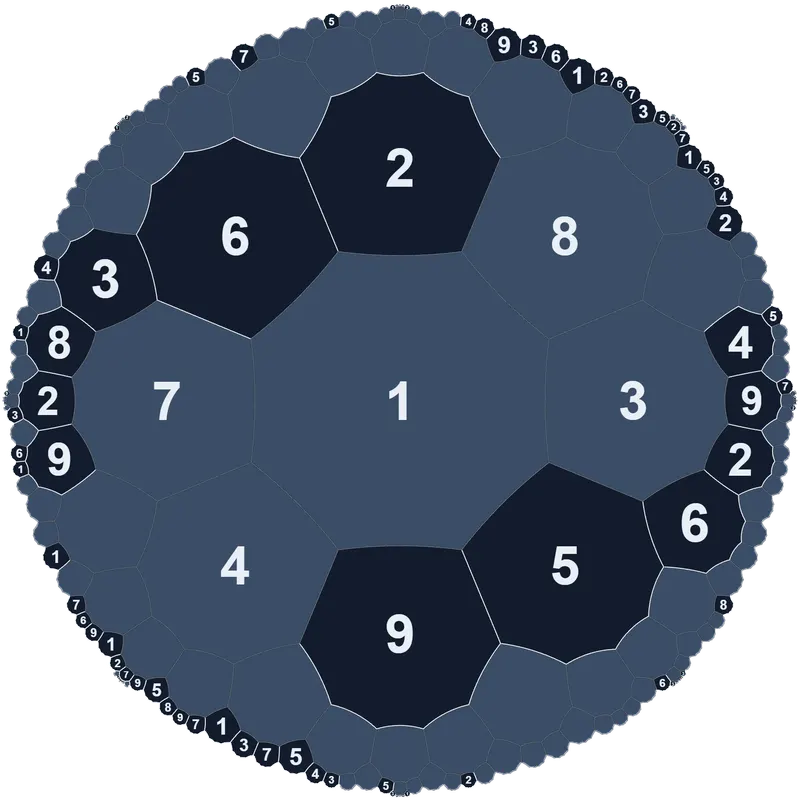
To complete the puzzle, fill in each missing tile in such a way that no values are duplicated between that tile and the tiles touching its edges, nor between that tile and all other tiles that lie on its geodesic. Tiles that share corners but not edges aren't part of the rule.
Boards come in different shapes and sizes. Each board is constructed of tiles that are squares, hexagons, octagons, decagons, or dodecagons; that's the board's shape. The number of tiles meeting at each corner, three or more, is its spokes. An octagonal board with 3 spokes has three octagons at every corner. Tiles with more edges and boards with more spokes lead to much larger puzzles.
The puzzle above is an octagon board where three octagons meet at each corner — the same construction used in a typical game. Extra cells sit on the lines through the center so those geodesics have a full run of tiles. Tile values run from 1 to 9 on this board, but that will vary based on board construction.
On the rules page, the highlight starts on the center tile: every lit tile shares a side with it or lies on a geodesic through it, and none of those values repeat. Notice that the same rule applies everywhere, not only at the center. On the rules page (opens in a new tab), you can drag to pan and hover or tap another tile to inspect its neighbors and center-through lines. While you're playing, the game will highlight the cell you're touching or hovering over, the cells bordering its edges, and the cells on its geodesics.
Hyperbolic Space
Space, as we know it in our day-to-day, is flat, essentially in the same way a piece of paper is flat. On a piece of paper, you can draw a grid by repeatedly drawing squares of the same size with no space in between. This can also be referred to as tiling. In addition to squares, you can also tile triangles and hexagons, but no other regular polygon. This type of space is called Euclidean space.
There also exist two types of non-Euclidean space, elliptic and hyperbolic space. These non-Euclidean spaces are considered curved, and elliptic and hyperbolic spaces are curved in opposite ways. Elliptic spaces are curved inward, just as the surface of a sphere curves in toward the sphere. In fact, elliptic geometry can almost perfectly describe the geometry of the Earth since the Earth is almost a perfect sphere.
Hyperbolic space gives rise to strange and beautiful new possibilities, not just to mathematics, but to physics, namely special relativity, and in my case, game development.
Inspiration for the Concept
I've always been interested in mathematics. Years ago, I first learned of the concept of hyperbolic space and other non-Euclidean spaces during a descent down a Wikipedia rabbit hole, first coming across Wikipedia's page on non-Euclidean geometry (opens in a new tab), where I eventually found myself on Wikipedia's page on hyperbolic space (opens in a new tab). I found it fascinating, so I searched other websites and found various visualizations, as well as small indie games and even art, such as M.C. Escher's Circle Limit III (opens in a new tab), a woodcut of a 2D hyperbolic space as rendered by a Poincaré disk model.
Many months later, I came across this video, a teaser for a game called Hyperbolica:
Unlike the previous indie projects I'd encountered, this was a fully three-dimensional game. Even in this old trailer, the graphics were considerably better than those of games I'd previously encountered. The current trailer is shown below, and the game is currently available on Steam (opens in a new tab). I've played it through more than once and I can personally recommend it as a fun, interesting, and original game, especially for those who enjoy indie games or games with unique concepts.
 A little over two years after this game was launched, I released my first game, Hexakai (opens in a new tab): A Sudoku-inspired game of hexagons. This is a game played on a diamond-shaped board of hexagons where every row and diagonal must consist of non-repeating values.
Once this project reached maturity, I began brainstorming concepts for new games to develop. My previous experiences with non-Euclidean geometry inspired me to make a similar game in two-dimensional hyperbolic space. I tabled the idea until August 2025. When I began in earnest, I knew I'd need to gain a deeper understanding of the underlying mathematics of non-Euclidean geometry, so I studied an introductory book on complex analysis and took notes in a small notebook. I started a new job in September, so I tabled the project again for some time, but in mid-2026, I continued my studies, then moved to an introductory book on hyperbolic geometry, while simultaneously reading up on articles directly related to my project.
Once I completed my studies, I began focusing on the challenging problem of determining the rules of the game itself and the manner in which to construct its boards. I found that many of the interesting aspects of Hexakai do not translate to Hyperkai, mainly that of triangular-elimination, a strategy in Hexakai that enables you to eliminate a value from a cell by checking if an equilateral triangle can be formed with two other cells such that assigning that value illegally precludes that value from both other cells. In hyperbolic space, straight lines (geodesics) diverge from each other, so triangles like Hexakai's, whose edges span more than one tile, cannot be formed at all within the board. Other constraints, and liberties, imposed by hyperbolic geometry precluded almost every idea I originally created during my brainstorming sessions.
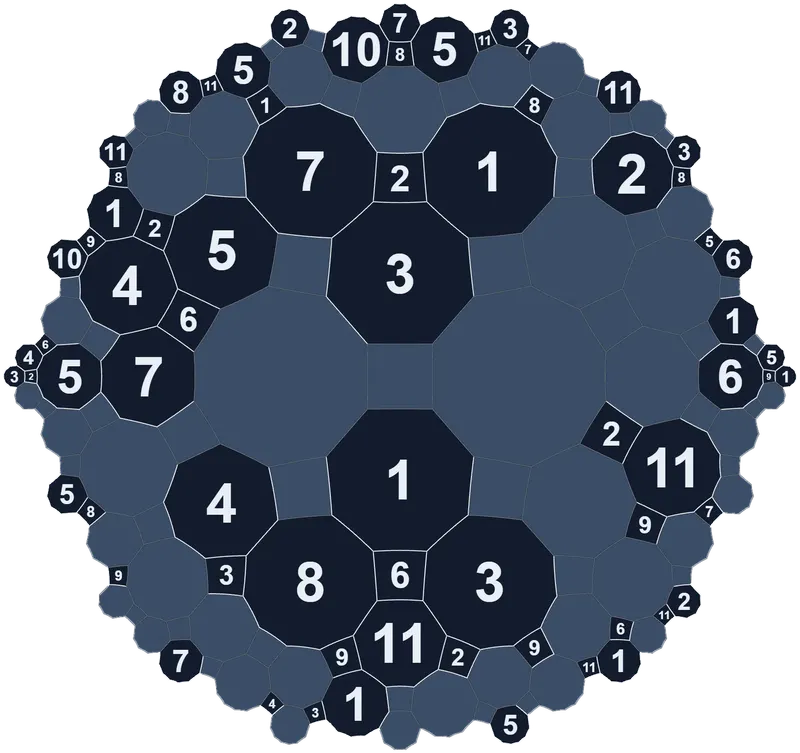
I eventually settled on a set of rules and a procedure for constructing boards that allowed for a large variety while satisfying certain invariants I desired. Hyperkai currently generates boards of different tilings and constructions that provide a wide range of gameplay experiences. I particularly enjoy boards which mix different sized tiles, such as the board shown below.
I've always enjoyed learning how ideas feed into newer ideas, which themselves feed into newer ideas, and so on, and I enjoyed participating in this process for my own project.
You can play the Hyperkai beta now at hyperkai.io (opens in a new tab).